An embedded FPGA (eFPGA) is an FPGA that’s incorporated into a system-on-chip (SoC). The eFPGA IP can be customized to meet application requirements. As a result, a developer is able to specify most aspects of the chip design, such as the number of lookup-table (LUT) logic cell, interface blocks, and specialized blocks like DSP blocks.
I talked with Mao Wang, Entrepreneurial Product Manager at QuickLogic, about the company’s eFPGA technology (watch the video above). Normally, developers will incorporate QuickLogic’s eFGPA IP into their SoC or into their chiplet-based design. The design can specify the eFPGA configuration, including the number of LUTs, RAM, and DSP blocks.
The EOS S3 (see figure) is a SoC developed by QuickLogic that includes an Arm-M4F core along with an eFPGA. The chip is available now, as is a SparkFun QuickLogic Things Plus development board.
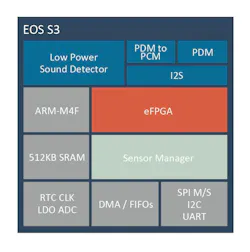 QuickLogic EOS S3 SoC
The EOS S3 is a system-on-chip from QuickLogic that includes an Arm-M4F core along with an eFPGA.
Chiplet-based designs can take advantage of Yorchip’s Universal PHY. The PHY supports UCIe and Bunch of Wires (BOW) standards. QuickLogic works with multiple foundries and chip technologies. Therefore, developers can choose support for 12 nm or smaller to gain performance while 22-nm versions can be used to reduce codes and improve power efficiency.
Source: Electronic Design