As AI infrastructure grows, most of the attention naturally goes to GPUs, high-speed networking, and large-scale storage. But one essential part of the system is often treated as an afterthought: the boot drive.
In cloud and enterprise AI environments, boot drives do much more than start a server (Fig. 1). They help determine how quickly systems come online, rejoin a cluster, and return to active workloads after maintenance or failure. That makes them central to uptime, resilience, and overall fleet efficiency.
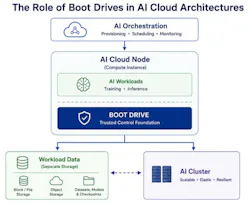 Role of Boot Drives
1. Boot drives are a critical part of AI cloud architectures with AI orchestration.
This is why boot storage has become a strategic issue for AI-era data centers. Modern AI systems are no longer simple server deployments. They bring together CPUs, GPUs, accelerators, orchestration software, networking, and distributed storage across large and complex environments. The boot drive supports trusted boot, system initialization, configuration management, and the reliable startup of the services that keep the platform running.
AI workloads also put new pressure on cloud infrastructure (Fig. 2). Providers need to bring nodes online quickly, recover from failures without delay, and keep behavior consistent across thousands of systems. To do that, boot drives require low latency, high IOPS, strong endurance, and dependable security. When boot storage slows down, the effects show up quickly: longer recovery times, lower GPU utilization, and higher operating costs.
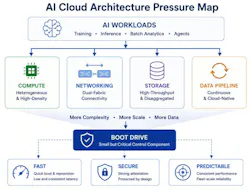 AI Cloud Architecture Pressure Map
2. This AI Cloud Architecture Pressure Map shows how the boot drive is a small but critical system component.
In Silicon Motion’s latest whitepaper, the company makes the case that boot drives in AI data centers should be PCIe NVMe solid-state disks (SSDs). Compared with mechanical drives, SSDs deliver the speed and consistency needed for rapid boot cycles, frequent reprovisioning, and continuous management activity. They also help maintain predictable performance in environments where even short delays can affect orchestration and cluster availability.
Silicon Motion's enterprise PCIe NVMe boot SSD solutions are built for these AI infrastructure demands (Fig. 3). Their controller and firmware capabilities are designed to support fast, predictable boot performance; power-loss resilience; secure boot; and large-scale manageability. For cloud providers operating at scale, these aren’t optional extras. They’re part of the operational foundation that keeps AI systems secure, efficient, and available.
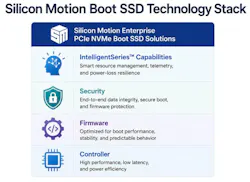 Boot SSD Technology Stack
3. Silicon Motion’s Boot SSD Technology Stack targets PCIe boot SSD applications.
In today's AI data centers, the boot drive isn’t a commodity. It’s a control point. High-capacity storage may serve data and model workloads, but boot storage anchors the system's state, identity, and ability to recover. That role becomes even more important as AI factories become more distributed, more heterogeneous, and more dependent on automation.
For AI infrastructure teams, the takeaway is clear: boot drives should be chosen for IOPS, reliability, endurance, and security, not just capacity. That decision has a direct impact on uptime and service quality. If you’re building or operating AI infrastructure, the boot drive is no longer a background component. It’s a foundational part of AI platform performance.
Reference
- Silicon Motion whitepaper on boot drives in AI data centers: “Boot Drive Requirements in Cloud AI Architectures” (referenced in the article as "our latest whitepaper"; download linked via the CTA).
Source: Electronic Design