What you'll learn:
- The issues associated with high-current sensing using the voltage drop across a known resistor.
- How four new series address those micro-ohm challenges.
- Why the inclusion of a thermistor and small connector simplifies design-in.
Current-sense resistors may not be glamorous, but they’re essential. These devices are tasked with developing a small voltage drop across their accurately known resistance, which allows determination of current magnitude in real-time by use of Ohm’s Law and voltage drop. Typically, the sensed voltage is on the order of 100 mV, so the resistor is sized to match the expected maximum current value (see “5 Current-Sensing Resistors” and “Using Resistors for Current Sensing: It’s More Than Just I = V/R”).
As load currents reach into the hundreds of amps, these modest passives devices need rugged, low-resistance physical connections, low temperature coefficient of resistance (TCR), stability despite self-heating, and, of course, milli-ohm and micro-ohm nominal resistances.
The Bourns CSI2F-6918, CSI2F-7036, CSI2F-8518, and CSI2F-8536 series of current-sense resistors are designed for this scenario (Fig. 1). They’re available in resistance values from 25 to 200 μΩ, all with a 36-W power rating at a terminal temperature of 125°C. Each of the four series, with their overlapping ohm values, offers an operating temperature range from -40 to +125°C with a resistance tolerance of ±5%. Applications range from battery-management systems to welding equipment.
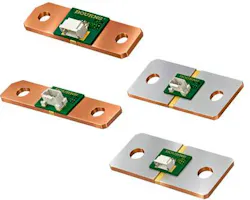 Four Bourns micro-ohm current-sense resistors
1. The four similar yet distinct series of current-sense resistors with overlapping micro-ohm values can handle power up to 36 W, even at high temperature.
What’s the difference among these four series? Somewhat surprisingly, the brief press release never clarifies this point, but some datasheet detective work revealed it is a slight difference in footprint (and height), with footprints of approximately 18 × 52, 36 × 50, 18 x 60, and 36 x 60 mm, respectively. The datasheets also reveal each series has a very slight difference in temperature dependence on resistive material, which is defined as ΔR (compared to resistance at 25°C) versus temperature.
Another interesting point, which is mentioned in the press release but not explicitly stated in the text of the datasheets, is that each unit contains a standard 10-kΩ negative-temperature-coefficient (NTC) thermistor. The NTC thermistor can be used to sense the temperature of the sense resistor itself, for a calibration/compensation and overload safety feature needed in some applications. The existence of that thermistor is “buried” in the mechanical drawing on the datasheet but not otherwise mentioned (Fig. 2).
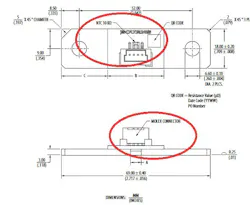 CSI2F-6918 Series dimensional drawing calling out the NTC thermistor and Molex connector
2. The dimensional drawing — here, for the CSI2F-6918 Series — calls out the existence of the 10-kΩ NTC thermistor (upper) and the four-pin Molex connector (lower), both circled in red.
Also not mentioned, but called out in the same drawing, is the 4-pin Molex connector with two leads for reading the voltage across the resistor and two for reading the thermistor resistance.
A nice feature of these connectors is that Bourns offers all of them in both vertical and horizontal orientations, as clearly seen in the photo of Figure 1. Although this may seem like a minor consideration, it can minimize headaches in the dense cabling environment of a real system with respect to wiring harness orientation, strain relief, and tie-downs.
Source: Electronic Design