While vehicle electrification continues to accelerate, its pace and direction is being tempered by market realities such as consumer reluctance due to range anxiety, high cost, and a lack of charging infrastructure readiness.
Energy circumstances differ by region as does customer needs and preferences. For example, some regions prefer heavy-duty vehicles (especially in the United States, where nearly half of the population drives a pickup truck). That’s why providing a full array of powertrains is necessary if automakers are to reach carbon neutrality. In response, the strategy being developed to meet diverse mobility needs is to move away from a one-size-fits-all approach.
Instead, engineers are looking at every item in their toolbox. In addition to pure battery electric vehicles (BEVs), for instance, this includes plug-in hybrid electric vehicles (PHEVs), hybrid electric vehicles (HEVs), internal combustion engines (ICE) optimized for carbon-neutral fuels, hydrogen engine vehicles, and fuel-cell electric vehicles (FCEVs).
Toyota’s new hybrid system centers around an entirely new 4-cylinder 1.5-litre engine family — offered in both naturally aspirated and turbocharged versions — designed from the ground up for electrification (Fig. 1, see image above). Toyota’s multi-pathway approach is being developed to provide practical and accessible solutions to help customers contribute to carbon reduction,
Key Details of Toyota's New Hybrid System
- The system combines a new family of four-cylinder 1.5-liter engines with lighter and more compact electric motors, power control units, and inverters, The naturally aspirated version replaces the performance span of current 1.8-liter engines and 1.5-liter 3-cylinder engines. The hybrid system is much smaller and is designed to deliver improved BEV performance and enable sleeker and more stylish vehicle design.
- The engine, electric motors, power control units (PCUs), and inverters are developed together as a single compact unit to cut electrical and mechanical losses.
- Toyota is targeting an improvement of more than 15% in fuel economy through reduced friction, better thermal management, lower electrical losses, and improved aerodynamic drag (lower Cd).
- The smaller, lower-profile package fits into a common multi-pathway architecture shared by BEV, PHEV, and HEV models (Fig. 2).
- The shared architecture allows for lower hood lines and more dynamic vehicle proportions without sacrificing interior space, cabin capabilities, or uncompromised BEV performance. It also lets factories seamlessly alter production mixes to fit shifting market demands.
- The system is being developed to run on renewable and carbon-neutral fuels. This extends the contribution that combustion-based electrified vehicles can make to reduce emissions while battery-electric and fuel-cell electric technologies continue to expand.
- Toyota’s multi-pathway platform employs a common architecture intended to enable manufacturing operations to seamlessly adjust the powertrain mix to match customer demand.
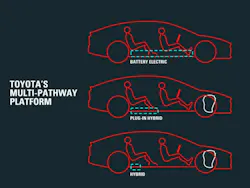 Toyota multi-pathway approach offers a range of electrified powertrains
2. The multi-pathway approach offers a range of electrified powertrains intended to simplify adjusting the mix to market demand.
Supporting Carbon Neutrality
Toyota plans to increase external sales of its new engine and hybrid technologies in the coming years. To date, the company has sold over 35 million electrified vehicles worldwide. It also has made over 24,000 patents for advanced electrification technologies freely available. These include the core systems that are used in all types of electric and hybrid vehicles.
Source: Electronic Design